Maori Design Meanings

Every carving has a very special meaning or story behind its design.

The carvings based on Maori designs in particular have special significance. The pre-European Maori had no written language so tribal history and the stories of the gods were kept using many forms of fine arts and crafts ranging from basket and cloth weaving to complex wood, bone, shell and jade carving. These artifacts were then handed down through generations of tribal elders and became sacred objects or treasures "Taonga", telling the history of a tribe and taking on the spirits of past great leaders and warriors who had worn them.
It is believed that a carving which is worn with respect or given and received with love, takes on part of the spirit of those who wear or handle it. In this way it becomes a spiritual link between people spanning time and distance. A carving that has been worn by family or tribal members over many generations contains the spirit of all of those people and is truly a great and powerful treasure.
Pendants, jewelry and various tools such as needles, spear tips and fish hooks made from bone developed into a fine art form with great importance being placed on every piece, many of which took years to make using stone tools. Some have inlays of precious stones or colourful shell and all have a story or meaning behind their design.
The Maori have a great respect for nature and have many legends about the creation of the earth and all its inhabitants. Many of these legends revolve around the spirits or gods who created or protect each part of their world such as the mountains, the forests, the lakes and the creatures of the sea.
Most carvings combine elements from several areas of mythology which interact with each other to tell a story. Each element has its own specific meaning and the way they are portrayed or combined is what gives a carving its own special character.
The meanings of some elements vary from region to region but all share common roots.
Some Basic Design Elements & Their Meanings
Koru:
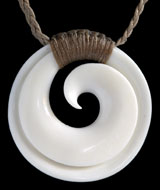 The spiral is a Koru, represents the fern frond as it opens bringing new life and purity to the world. It also represents peace, tranquility and spirituality along with a strong sense of re growth or new beginnings.
 The Koru is also often associated with nurturing so when interlocked with others is frequently used to represent the strength and purity of a loving relationship within a family.
Twist:
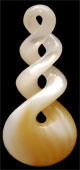 The twist with its crisscross form represents the many paths of life and love and as such
is regarded as the original eternity symbol. The single twist in particular shows the joining together of two people for eternity. Even though they sometimes move away from each other on their own journeys, they will always come together again sharing their lives and blending to become one. It tells how the strength of bond of friendship, loyalty and love will last forever.
The double and triple twists have a similar meaning but refer more to the joining of two peoples or cultures rather than individuals.
They also refer the the three baskets of knowledge.
Hei-Matau:
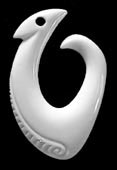 These very stylised fish hooks represent strength, prosperity,abundance, fertility and a great respect for the sea.
It also is said to provide good luck and safety when traveling over water so is often worn by travelers.
Hei-Matau are also symbols of power and authority which are held in great reverence by the Maori people.
They were used as a practical tool for fishing and were often decorated as a sign of respect for the creatures of the sea.
There are many styles of Hei-Matau from the true hook designs to the more ornamental styles which became treasured heirlooms for generations following.
Manaia:
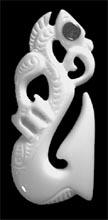 The Manaia is an ancient mythical being with a birds head and a human form. It is said to be the messenger between the earthly world of mortals and the domain of the spirits illustrating the strong links the Maori people have with spirituality and the spirit world.
It is a holder of great spiritual energy and is a guardian against evil.
The Manaia can be seen blended into many Maori designs with subtle differences between tribes.
The Manaia is often depicted with the three fingers of birth, life and death. It can also be shown with a fourth finger representing the afterlife and describing the circle of life.
Circle:
 The closed circle is said to represent the circle of life which is has no beginning or end, is seamless and of which we are all a part. It also tells of the stars and planets which are part of the circle of life and contain the knowledge of our origins.
It is often used to enclose other elements such as the Koru, linking love and new life or new beginnings with the circle of life.
For an artist the circle represents the relationship or oneness between the artist and his craft, bringing together head, hand and heart.
Tiki:
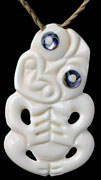 The Tiki is a very ancient symbol and is by far the least understood so there are a number of legends about its meaning.
Some say he came from the stars and that he was the first man of the world. He is also often depicted with webbed feet which suggests a strong link to the creatures of the sea.
Tiki was respected as the teacher of all things and the wearer of this symbol is therefore seen to possess clarity of thought, loyalty, great inner knowledge and strength of character.
The Tiki is regarded as a good luck charm when worn and in some areas is also regarded as a fertility symbol.
 Toki:
Toki:
 Toki:
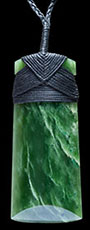
Toki:This design represents the Toki or Adze ("adz" in American English) which was used to carve the great canoes and also to cut and work timber for the fortresses or Pahs in which the Maori lived.
It was such an important tool in Maori life that it became regarded as a symbol of power, authority and good character.
It is also the mark of the craftsman and artist.
Whales, Dolphins and Turtles:
The ocean has always been the dominant force for the Maori people who traveled huge distances in their long canoes and lived on the bounty of the tropical waters. They had a great respect for the creatures on the sea and in particular dolphins and whales.
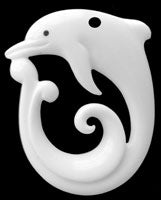 The whale with its great size and obvious intelligence played an important part in the culture of the Maori people. They were often represented as an example of family love with mother and calf always side by side and touching at every opportunity.
Beached whales were treasured as gifts from the gods. They were particularly prized for the bone which after several years of curing was used to carve ornate jewelry and art works, often passed down for many generations.
A dolphin is a symbol of playfulness, harmony and friendship while the turtle is the sign of a navigator.
================================
Materials:
Our artist work in a wide range of materials including, bone, jade, deer antler, mammoth bone, pearl shell, wood, tusks and horns, bowenite, stone, and obsidian.
Each material has its own special properties making it ideal for certain designs and often a combination of several materials together can create something really extraordinary.
For more info about some of the materials we use and their care go to: Bone Art Place Materials Info
=============================
Copyright Notice:
These descriptions and meanings have been written by our artists and are NOT to be copied or used without our express consent.
Many have been stolen and quoted word for word by some dishonest traders and auctioneers.
If you see these descriptions quoted word for word on any local auction listings or similar you can be very confident that they are a dishonest trader.
Blatant theft of copyrighted material such as this goes hand in hand with, low quality fake merchandise and high risk transactions.
Do not support dishonest traders who rip off the real artists, they also rip off their unsuspecting customers.